Colston’s Last Journey has just been launched (as part of the Bristol Festival of the Future City) on October 17/18/19 2023. I will be blogging about it soon!
Colston’s Last Journey (Worldwide) is also being launched today (20 October 2023). I hope I have enabled comments – so please (1) share where you tried the work out (I will be building a map showing all your locations if you send them to me); and, (2) please comment on what you think of it (comments will be moderated). Thanks!
No, I haven’t posted to the Colston’s Last Journey blog for quite a while (say 9 months…). The whole project has been considerably delayed because of serious illness, so I asked the Arts Council if I could launch in Spring 2023 instead of the intended ‘Autumn 2022’, to which they acquiesced (thanks, ACE!). It also makes sense now to tie the project in with Bristol650 – the celebrations of 650 years of Bristol’s history in 2023.
So here we are now – end of December 2022, 28th, to be precise. Not that Colston’s Last Journey has simply sat there since April, and, though I perhaps shouldn’t say this, the delay has been good for me and for the project – a bit like a maturation period, where experimentations, thoughts, the content, the expression, feelings etc have had the time and space to mature, find their own expression, rather than being pushed by a deadline and my own preconceptions of what the work should be.
Structurally, it’s now quite clear (or it is until it all changes! Plus ça change..)
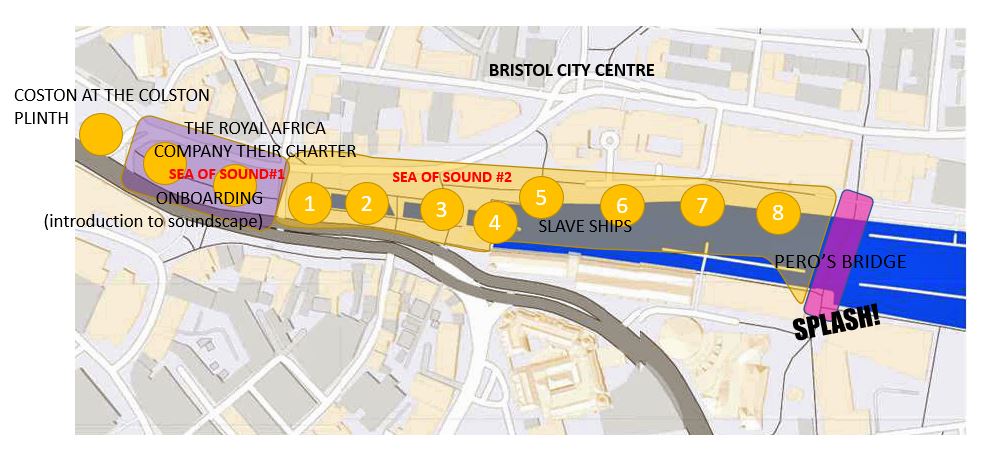
COLSTON AT THE COLSTON PLINTH: enter the soundscape at the Colston Plinth. Listen to contemporary (to the time) expressions of Colston’s philanthropy
THE SEA OF SOUND #1: interactive audio which changes with what you do when navigating the sea of sound by moving through it
THE ROYAL AFRICAN COMPANY THEIR CHARTER
ONBOARDING: introduction to the soundscape/how it works etc
SEA OF SOUND #2: as above, with different audio
SLAVE SHIPS: discover and board each of the eight slave ships which sailed from Bristol in the 17th and 18th centuries, each one of which represents one aspect of the transatlantic trafficking of enslaved Africans.
PERO’S BRIDGE; continue on over Pero’s Bridge to the end of the soundscape
Conceptually, I think I’m much clearer now on the conceptual space the soundscape inhabits. My heritage-based located audio work always involves re-imagining authentic historical scenarios from as many angles as there are available (from my research and my partnership with the Regional History Centre of the University of the West of England). I script-write these multiple POV scenarios and layer them over physical locations. It is up to the participant, the hearer – the navigator, literally, of the soundpools – to create their own experience, their own angle on what is going on/what went on, without this being prescribed to them. A somewhat difficult approach to stick to when such highly emotive protagonists so inextricably interwoven into Bristol history amid such contested (well, the history is uncontestable) histories as Edward Colston are involved. Nevertheless.
The soundscape thus starts at the Colston Plinth. You will have downloaded the app from the appstore or Google Play beforehand and brought your headphones/earbuds along with you.
You open the app at the Colston Plinth. You will hear contemporary accounts of what the name ‘Colston’ meant to Bristol and Bristolians during his life and for a long time afterwards: no apologies, no ‘context’, no interpretation, no filters – exactly as reported.
We then cross the road and enter the first sea of interactive sound. Lost voices keen and call, swear, sing, curse, spiral in to you, spiral out again. We bump into a recitation of The Royal African Company Their Charter – again, played with a straight bat from original documents.
Suitably primed, we next encounter what is called in the games industry a bit of ‘onboarding’ – an introduction to the soundscape and how it is built and a few tips as to how to navigate it. Not too many- I hope it is fairly intuitive.
Over the road again where the historical drawbridge used to be located. We are now on Broadquay, one of the quays from where the slave ships actually sailed in the 18th and 17th centuries.
Afloat, again, on another sea of sound. A time warp, Dr Who-type ‘swoosh’ hits you – and you’ve found and boarded the first slave ship. You will experience one aspect of the slave trade as symbolised by this ghost ship. Swooooosh! leave the ship, re-embark on the sea of sound. Continue moving towards the Cascade and the open waters of the Bristol Floating Harbour. Continue discovering slave ships.
Move to the left of the open quay’s waters and continue down towards Pero’s Bridge. Here the soundscape changes again as you go over the bridge. HIt the far end of the bridge.
SPLASH! This is where the Colston statue was flung into the docks in June 2021. An appropriate end to the soundscape. Go and get a coffee from one of the many cafes or bars which are now around here. Listen to the sounds of the water, the boats, the people with different ears.
I’m well aware it’s been rather a long time since I last posted here. The main news is that, due to illness, things is postponed, folks! I’m now NOT launching Colston’s Last Journey in May this year (2022) as originally planned. I had been thinking, ‘ok – maybe autumn 2022 instead’, but then Bristol Ideas (one of the supporters of Colston’s Last Journey) said, ‘why don’t you include CLJ as part of the Bristol 2023 (650 years of ‘Bristol’, I understand) celebrations next year?’ So I discussed it with my partners (Steve Poole at UWE and Phill Phelps, my Satsymph colleague) and we all think it could be a good ideal to tap into that. So I’m now looking at spring 2023. Thanks Arts Council for being understanding!
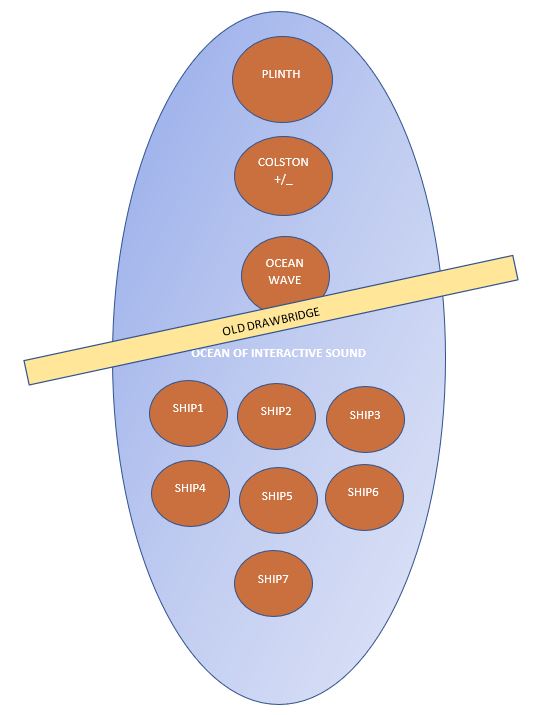
We recorded my scripts on 18 March nonetheless with 3 voice actors and I have just finished the first rough audio edit. The concept has also excitingly developed further as per the above infographic: the problem – well, not ‘a problem’, ok, the issue was ‘what will the sound experience on the 7 ghost slave ships be???’ The thing being that there is A LOT of content and in the Satsymph experience of making soundscapes we have generally found that anything more than, say, 4 minutes per soundclip was too much. But here we are talking 20-30 minutes of sound! WTF!
Solution came to me in a blinding flash of purple light (from whatever realm that cometh from, namaste!): the content, be it 10, 20, 30 minutes, whatever, is on perpetual loop. The onlistener, when they ‘board’ that ship (ie find it afloat somewhere along along Broad Quay on the sea of sound) simply tap into wherever that loop is at that moment. ULRIKA, er, EUREKA! Solves all the technical wotsits, guarantees ‘the individual experience’ (since everyone will tap into that particular loop at a different time), simple, elegant. Gebonkt.
Er, for all the reasons I listed in my last blog post (and more!) the title has reverted to the original: Colston’s Last Journey. Signed: a Flaky Artist
I have today changed the title of my sonic artwork on Bristol and the Transatlantic Slave Trade from ‘Colston’s Last Journey’ to ‘Shipshape and Bristol Fashion?’ (note the ‘?’)
Why?
My intensive research over the last 9 months into all aspects of the Transatlantic Slave Trade (also called TTEA: the Transatlantic Trafficking of Enslaved Afrikans) means that I have a greatly increased appreciation of the scope, scale and complexities of the trade in an overall African/British context and am reflecting that in the scripts I’m currently writing for the audio artwork. The whole project has thus expanded very much beyond ‘Colston’ and a focus on ‘Colston’ in the title of the project simply does not fit the direction the project has taken anymore.
Calling my project ‘Colston’s Last Journey’ gives rise to the participant (and media) expectation that the project is about Colston, when – as stated in my Arts Council application – it’s actually about Bristol and the Transatlantic Slave Trade. It won’t help the project if I am continually having to explain, “er, actually, the audio work is not about Colston, I’m using him as a place marker or signifier or representator of …“, or, “no, it’s not about that day in June 2020 when his statue was toppled off the plinth and dragged through the streets of Bristol, it’s about…”.
‘Shipshape and Bristol Fashion?’ frees me from the bane of that man’s long shadow, refers more indirectly to the seafaring tradition in Bristol and exactly who and what was being ‘sea-fared’, and brings the focus of the project back onto the work and how it is structured: a sea of interactive sound overlayers the historical and present Broad Quay (‘the Centre’ of Bristol). Upon this interactive sea, 7 ‘audio ghost ships’ are afloat, each representing a different facet of the slave trade, each of which was an actual ship which set sail from Bristol in the 17th and 18th centuries.
The project still references the whole Colston debacle in that the audiowalk still starts from the Colston plinth and ends where his statue was thrown into the water. Just that the connection is then made by the audience if you so wish. It is not explicitly stated by the artist, but implicit within the work.
Scribbled these down in bed after leaving them to stew for a few weeks.: the 7 audio ghost ships are afloat on the sea of interactive sound. The content is stacked or playlisted (makes multiple visits to the same ship possible: if you have heard Content1, you will then hear Content 2 etc). In no particular order as yet:
SHIP1: the sailor experience (1) Joseph Banfield stranded in Africa (2) on ship accounts (3) dependents’ accounts
SHIP2: 1st person slave accounts (x3 or more)
SHIP 3: The floating prison (how a slave ship was organised and constructed)
SHIP4: The floating supermarket: what goods were traded and for how much
SHIP5: slave resistance in its multiple forms
SHIP6: SFX, non-narrative
SHIP7: ship instructions (the shipowners orders to the captain – where the ship is to go, what she is to do there etc)
Making art is about being vulnerable (before your material, before your audience). You have to place yourself in front of the material and allow it to say what wants/needs to be said filtered through your particular sensibilities of accidental origins, influences, thoughts. That’s an opening up process and thus always difficult. For years I’ve had a newspaper cutting on my pinboard – the point of a pinboard, is, I think, to pin up things of current concern, current interest, bills you need to remember to pay, receipts for things you’ve bought, wise aphorisms, things which catch your eye … but the key word is CURRENT. I’ve never managed to do that – I like the things pinned to my pinboard so much I never replace them, keep them up to date; I’ve got stuff on there from, oh, 1994 .. anyway, where was I? …and one of the cuttings says:
“You’re stuck writing something until the point where you go, to hell with it – I’ll tell the truth“
Liz Lochhead
‘Truth’ does not come in a tidy, ideologically-approved bundle and it can’t be constrained in advance: it exists only here, now
The other cutting says:
“It’s hard enough to write. I’ve had my mother, nuns and priests telling me what I shouldn’t do. I want to be free.”
Edna O’Brien
So, the necessity to write what is, not what one is supposed to.
“IfI can’t dance I don’t want to be in your revolution”
The problem with CLJ (Colston’s Last Journey) is the usual: there’s absolutely no end to the amount of research which could be done, nor is there an end to possible material for inclusion, so, at some stage, I really need to say, ‘that’s it!’ But then something else pops up and I think, ‘really should include THAT...’ But, no… can’t go on for ever – it’s getting time to PRODUCE something
So I have to think about the framework, the structuring of the work
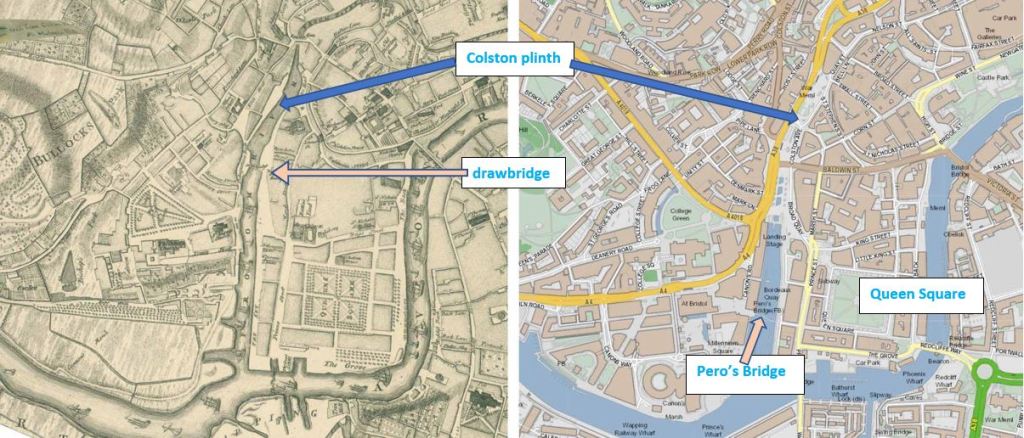
this is sort of it: the structural constraints are that it has to be laid out in a busy city centre (buses, cars, people, water features, bicycles), but, luckily the whole route is pedestrianised and somewhat apart from the traffic, so that’s ok; then, even tho’ it’s called ‘Colston’s Last Journey’, it does not, in fact, follow the whole route the statue was dragged, which was down the right hand side of Broad Quay past the Watershed etc, not where I am leading people, which is on the ‘rive gauche’, the left-hand side, from the water cascade – this is for practical reasons, (1) there’s no space on the right, the pathway’s too narrow; (2) the work is gps-triggered. I wouldn’t get a good signal on the right under the canopy and right next to buildings . So it’s to the left. Further, when the ghost ships were sailing, they would not have been able to get further up Broad Quay than the (site of) old drawbridge (in line with Baldwin Street). For reasons of historical veracity, then – no ships above the drawbridge.
START at the Colston plinth
INTRO/CHARTERS (re. Royal African Company &c)
TRIGGER OCEAN
INTERACTIVE OCEAN
DRAWBRIDGE
INTERACTIVE OCEAN as far as Pero’s Bridge, rive gauche (Arnolfini side of Broad Quay)
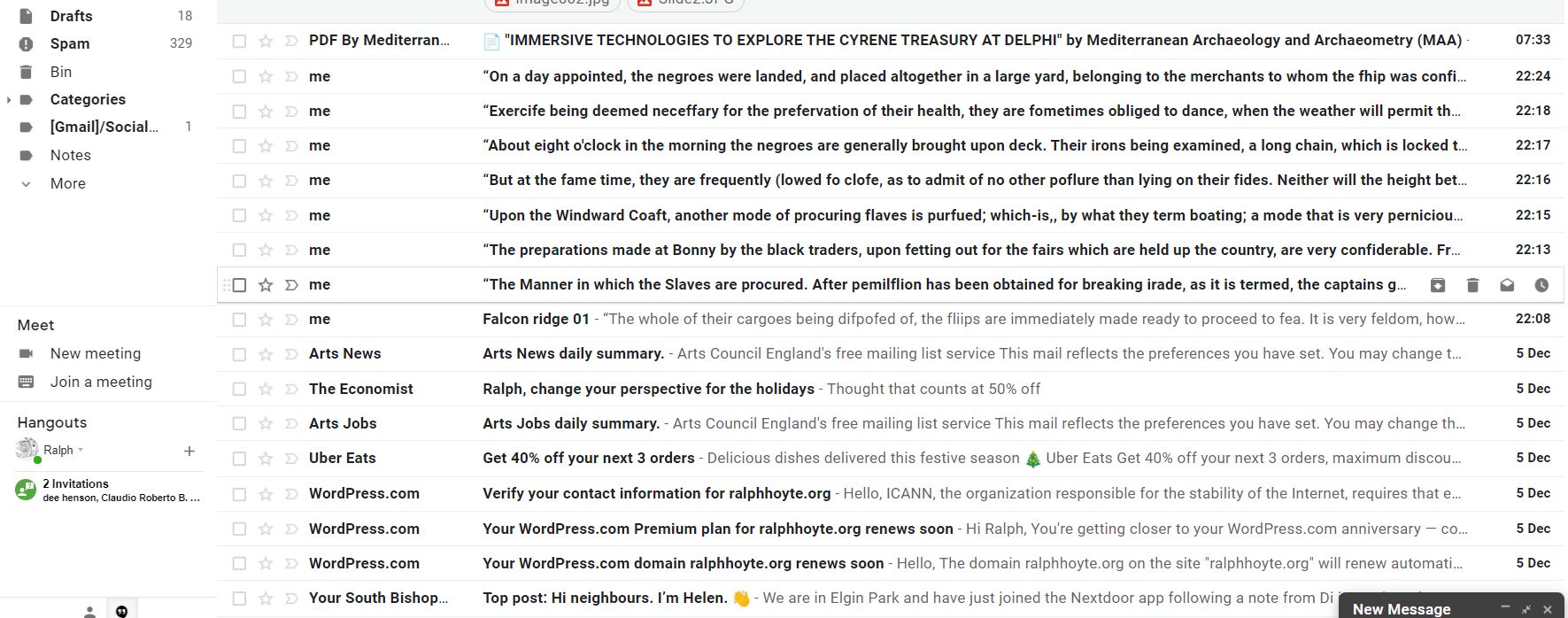
Waking up at 3am one night last week in London (up for a one-day zen retreat), I thought I’d read my Kindle ‘An Account of the Slave Trade on the Coast of Africa‘ by Alexander Falconbridge (c. 1760–1792) (he was a British surgeon who took part in four voyages in slave ships between 1780 and 1787). I scan-read the 660 pages in an hour (a useful ability facilitated by the eBook format), then copied and emailed the passages I wanted to myself:
That’s actually a good method, I think, for displaying research material, as the email, if the material is in a block, simply copies a lot of the first block as a title and produces a tantalising (and here disturbing) hint of what the email could contain, such as:
“The Manner in which the Slaves are procured.After permission has been obtained for breaking trade, as it is termed, the captains goashore, from time to time, to examine the negroes that are exposed to sale, and to make their purchases. The unhappy wretches thus disposed of, are bought by the black traders at fairs, which are held for that purpose, at the distance of upwards of two hundred miles from the sea coast, and these fairs are said to be supplied from an interior part of the country. Many negroes, upon being questioned relative to the places of their nativity have asserted, that they have travelled during the revolution of several moons, (their usual method of calculating time) before they have reached the places where they were purchased by the black traders. At these fairs, which are held at uncertain periods, but generally every six weeks, several thousands are frequently exposed to sale, who had been collected from all parts of the country for a very considerable distance round.“
Didn’t really sleep very well after that, so not such a good idea…
Fine – I got the money. Now, then… first thing I did was panic: ONE, I’m referencing ‘Colston’, that’s sure to get me into trouble with all sides of the ongoing debate. The man, the statue, the men, the statues are all triggers in plain view for, well, everything and everybody, and I don’t want to be in the firing line, thank you. TWO: how to, I mean, how dare I even consider making a work of soundart about the Transatlantic Slave Trade? What could do this justice (hah – ‘justice’!)? I’m making a work about the Transatlantic Slave Trade, yes, but I have to preserve, for my sanity, ‘artistic distance’. Yes, but how do you artify this? Is even artifying it an insult to our combined diasporic unconscious? THREE: what effect was all the research I was now embarked on going to do to me? I’m well used to grinding endless material and producing art out of it – but THIS? FOUR: my research removed a few blinkers from my eyes about what actually went on. It seems what went on does not fit the simplified narratives any of the various sides are propounding.
SOLUTIONS: to ONE: (a) I am very clear that ‘Colston’s Last Journey’ is not ‘about’ Colston, or even particularly references him. The soundart trail is called ‘Colston’s Last Journey’ because it overlayers Colston’s last journey from his plinth to where he was flung into the water and because his is an instantly recognizable name to hang the work on. My soundart is about Bristol and the Transatlantic Slave Trade. (b) just talk to everyone and tell them what you’re doing: this is an individual artist work supported by the Arts Council and I’m making a work of located soundart accessed through the participant’s personal smartphone whose topic is ‘Bristol and the Transatlantic Slave Trade’.
to TWO: making a work of art uses all the artist’s capacities as an artist is always creating de novo; always birthing what is to be in the world, what wants, requires, needs to be, is asking to be in the world. So it’s always a process of sheer panic, feeling inadequate, fear, loathing, joy and you have to trust that, at some point in the process, the work itself will open itself to you (like, when writing a novel, that wonderful point when the characters themselves start to dictate what they’re going to do and say to the ostensible ‘author’). So – trust the Ancestors, they will speak to me.
to THREE: I read something in a Guardian book review where the reviewer said something about ‘that ice-cold splinter in the heart of the writer’. Yes.


 Colston's Last Journey